
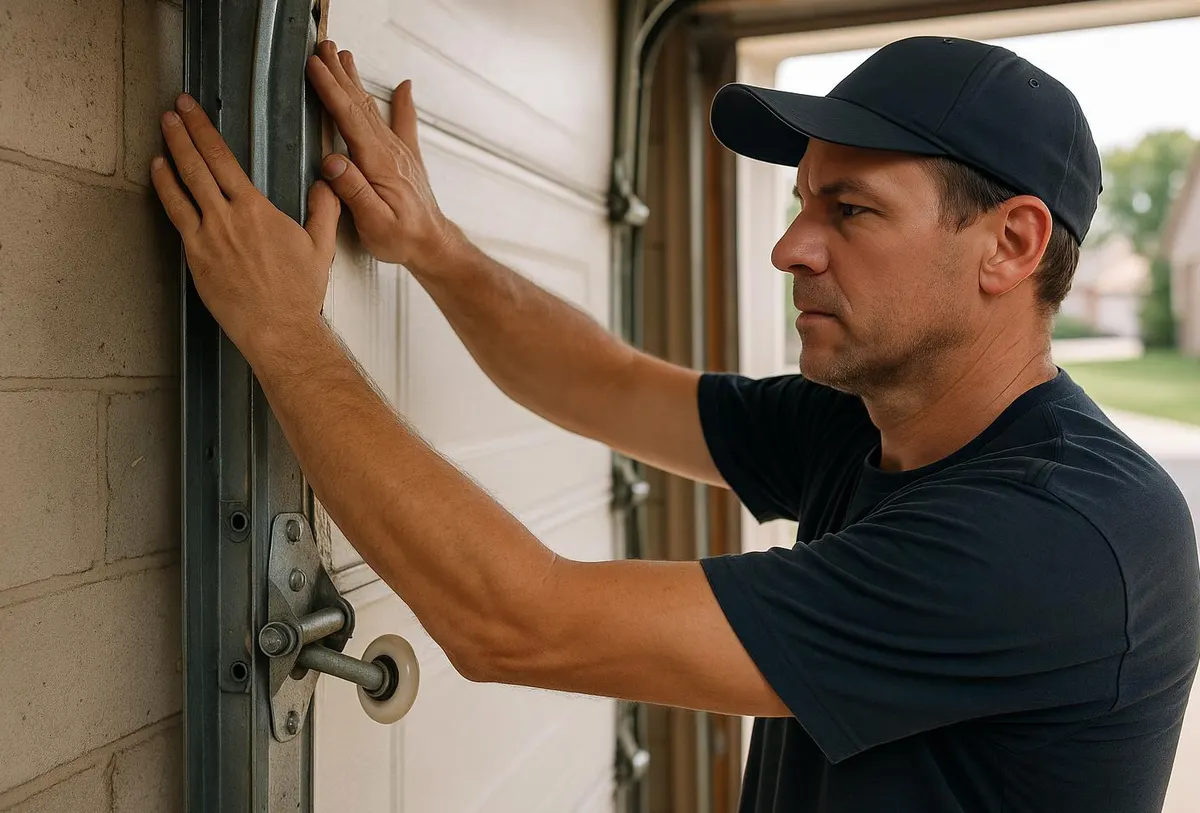
You hit the opener on a cold November morning, coffee in hand, and the door doesn't just open — it announces itself. A grind, a squeal, a pop, a rattle. You pause with your hand on the car door, half-listening, half-worried. Most homeowners around Shirley notice these sounds the same way: not all at once, but gradually, until one morning it's loud enough that you can't ignore it anymore.
The good news is that garage door noises aren't random. Each type points toward a specific part of the system, and most technicians check the same things in the same order. Here's what each sound usually means, and what fixing it actually involves.
Grinding: Metal-on-Metal Under Load
Grinding is a harsh, mechanical sound that happens as the door travels up or down, almost always tied to something rubbing where it shouldn't. It tends to get worse with cold — stiff, dry parts grind harder when the temperature drops.
- Worn rollers first. Plastic or nylon rollers flatten or crack over years of use, and that wear speeds up with temperature swings between humid summers and freezing winters. A tech checks these first because they're the cheapest fix and the most common cause.
- Rusted or debris-packed tracks next. Road salt and ice melt tracked in on tires, plus winter grit, can corrode the track or leave buildup that catches the rollers. Cleaning and lubricating the track usually solves this; a bent or heavily rusted track needs replacing.
- Dry or worn roller bearings. If the rollers themselves look fine but the grind persists, the bearings inside them may be dry or shot. Lubrication fixes early wear; replacement is needed once bearings are pitted.
- Opener motor bearings, last. If the noise is coming from the unit on the ceiling rather than the door itself, worn motor bearings are the likely culprit, and that's an opener repair, not a door adjustment.
Squealing: A High-Pitched Cry, Often First Thing in the Morning
Squealing is almost always a friction problem, and it's especially common on the first run of a cold morning before anything has had a chance to warm up and loosen.
- Lack of lubrication, checked first. Hinges, rollers, and springs all need periodic lubrication, and cold weather dries them out faster. A proper garage door lubricant (not household oil or WD-40, which attract grit) on the moving parts often quiets the door within one cycle.
- Worn hinges. The pivot points on metal hinges wear down over thousands of open-close cycles, and once they're worn, lubrication only helps temporarily. Replacement hinges are inexpensive and straightforward.
- A stressed torsion spring. If lubricating the hinges and rollers doesn't quiet things down, a spring nearing the end of its life can squeal under tension. Springs operate under enormous force and should only be handled by a trained technician.
- Opener chain or belt tension. A chain-drive opener that's run too loose or too tight can squeal with every cycle; this is a quick adjustment once identified.
Popping: A Sudden, Sharp Sound
Popping is the sound that makes people jump — a single sharp noise rather than a continuous one. It often shows up during the big temperature swings common to this part of Indiana, as materials expand and contract.
- Panel flex, checked first. Steel panels can pop slightly as they adjust to sudden cold snaps or temperature drops overnight. This is often harmless, but it's worth a visual check for new cracks or warping, especially on older doors.
- Loose hardware. Vibration from daily use gradually loosens bolts, screws, and brackets. A technician checks every connection point along the track and door frame and re-torques anything that's backed out.
- A spring at or near failure. If the pop happens along with the door feeling heavier, sticking partway, or not closing smoothly, a spring may be close to breaking or may have already snapped one coil. The door should not be operated until this is inspected.
- Track misalignment. A roller jumping a small gap where the track has shifted produces a popping sound as it re-seats. Realigning the track resolves it.
Rattling: Loose Movement Throughout the Cycle
Rattling tends to run through the entire open-close cycle rather than happening once, and it's often more noticeable during windy spring storms when the whole door assembly gets a workout.
- Loose hardware, checked first. Same root cause as popping — years of vibration loosen nuts, bolts, and hinge fasteners. Tightening everything along the track and panels is the first step.
- Worn chain or belt drive. A chain that's stretched or a belt that's lost tension will rattle against the opener rail with every cycle. Adjustment or replacement depends on wear.
- Loose trolley or arm connection. The piece connecting the opener to the door itself can work loose over time, especially on older installations, causing a rattle right at the top of the door.
- Loosened track brackets. Wind pressure from spring storms or just age can loosen the brackets holding the track to the frame. Re-securing them stops the rattle and keeps the track from shifting further out of alignment.
When to Call Shirley Garage Door
If lubrication and a quick hardware check don't quiet things down, or if any noise is paired with the door feeling heavy, uneven, or hesitant, it's worth having it looked at before a minor issue becomes a stuck door on a freezing morning. Shirley Garage Door's Garage Door Maintenance visits cover exactly this kind of diagnostic work — rollers, hinges, tracks, and hardware — and if a squeal or pop turns out to be spring-related, our Spring Replacement service handles it safely, since springs are not a DIY repair.
If your garage door in Shirley, Wilkinson, Kennard, New Castle, Knightstown, Morristown, Greenfield, or Carthage is making a noise you can't quite place, give Shirley Garage Door a call. We'll figure out what it's telling you and fix it right.